
Blogs
How Tour Operators Can Manage Guides, Drivers, Vehicles, and Equipment Without Daily Chaos
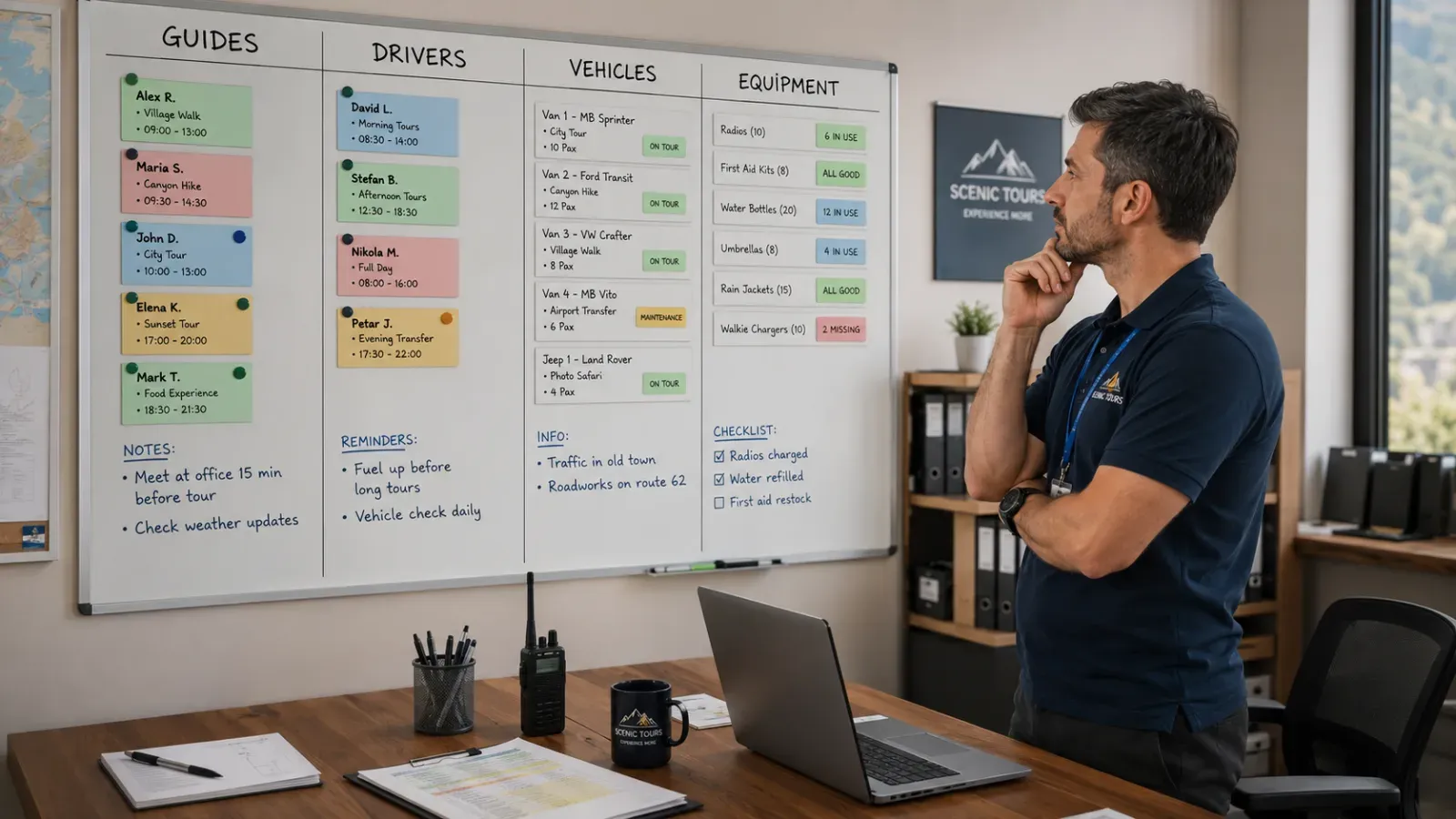
When a customer books a tour, the booking is only the beginning.
To actually run the activity, the operator needs the right people and resources at the right time.
A guide may be needed. A driver may be needed. A vehicle may be needed. Equipment may be needed. A vendor may be needed. Safety documents, permits, waivers, or briefing scripts may be needed.
If any of these pieces are missing, the booking can become an operational problem.
This is why tour operators cannot manage operations only with a booking calendar. They need to manage the real-world resources required to deliver the experience.
Why resource management becomes difficult
In a small tour business, resource management may be simple.
The owner knows which guide is free. The vehicle is parked outside. The equipment is easy to count. The same person manages everything.
But as the business grows, the operation becomes more complex.
There are more products, more start times, more guides, more drivers, more vehicles, more external vendors, more pickup routes, more equipment, and more customer expectations.
At that stage, trying to manage everything manually creates daily chaos.
Common resource problems in tour businesses
1. The same guide is assigned twice
A guide may be added to one tour in a spreadsheet and another tour in a calendar.
Or one manager may assign them to a private tour while another manager assigns them to a group activity.
This is especially common when teams work across different locations, languages, time zones, or product types.
The conflict may only be discovered on the day of the tour, when it is already expensive to fix.
2. Vehicles are available in theory but not in practice
A vehicle may exist in the business, but that does not mean it is available.
It may be under maintenance. It may be assigned to another pickup route. It may not have enough seats. It may not be suitable for the terrain. It may be rented and not yet confirmed. It may require a specific driver.
If vehicle availability is not connected to tour planning, operators may overestimate their real capacity.
3. Equipment status is not visible
Many activities depend on equipment: bikes, helmets, boats, cameras, wetsuits, radios, safety gear, tools, or other activity-specific resources.
If equipment is damaged, missing, expired, dirty, under repair, or already assigned elsewhere, the tour may be delayed or delivered poorly.
A spreadsheet can list equipment, but it often does not show live operational status.
4. External vendors are managed informally
Many operators work with freelance guides, transport providers, photographers, rental companies, local partners, or equipment suppliers.
These relationships are often managed through WhatsApp, calls, and memory.
That works until there is a dispute.
Who confirmed the vendor?
What price was agreed?
Which tour were they assigned to?
Were they late?
Was the invoice paid?
Was there a complaint?
Do they have valid documents?
Are they available next week?
Without vendor records, the operator has weak visibility and weak control.
5. Maintenance is handled too late
Vehicles and equipment need maintenance, inspections, cleaning, repairs, insurance, permits, and expiry tracking.
When these are not scheduled properly, resources become unavailable at the worst possible time.
A vehicle issue on a busy day can create cancellations, refunds, customer complaints, and emergency rental costs.
The real problem is disconnected scheduling
Most operators do not fail because they are careless.
They fail because the information is disconnected.
The guide schedule is in one place. The vehicle schedule is somewhere else. Equipment status is in someone’s head. Vendor confirmation is in WhatsApp. Maintenance reminders are in a calendar. Customer pickup details are attached to the booking. Costs are tracked later by finance.
When the operation is split across many places, managers cannot easily answer the most important question:
“Do we have everything needed to run this tour?”
What tour resource management should include
A good resource management workflow should help operators track:
Guide availability
Driver availability
Vehicle availability
Equipment availability
Resource condition
Maintenance schedules
Damage reports
Resource documents
Vendor contacts
Vendor pricing
Vendor assignments
Resource costs
Staff workload
Assignment conflicts
Capacity conflicts
Expiry dates
Utilization reports
This does not mean making the operation complicated. It means giving the team a clear picture before problems happen.
How Rebridpro approaches resource and team management
Rebridpro is designed as an operations management tool for tour and activity operators.
It does not replace the platforms where customers book or pay. Instead, it helps operators manage the operational work after bookings arrive.
For resources and teams, Rebridpro helps bring guides, drivers, vehicles, equipment, vendors, availability, assignments, documents, costs, and conflicts into one operational system.
That means an operator can see not only what is booked, but also whether the right resources are actually available.
The goal is to help teams prevent problems like:
A guide assigned to overlapping tours
A vehicle assigned to two pickup routes
Equipment booked while under maintenance
A vendor assigned without confirmation
A tour exceeding real operational capacity
A missing document or expired permit
A last-minute scramble for replacements
Why this matters for profit
Resource mistakes are expensive.
A last-minute freelance guide may cost more. An emergency vehicle rental may reduce the margin. A delayed tour may lead to refunds. Damaged equipment may stop a product from running. A poor vendor may create bad reviews.
The operator may still have bookings, but the profit disappears through operational fixes.
Better resource management helps protect the margin behind each tour.
Final thought
Tour operators do not just manage bookings. They manage moving parts.
Guides, drivers, vehicles, equipment, vendors, documents, costs, and customer expectations all have to come together at the right time.
When these parts are managed separately, daily chaos becomes normal.
When they are managed in one operational view, the business becomes easier to control, easier to scale, and less dependent on last-minute problem solving.
