
Blogs
Why Tour Operators Should Track Profit Per Tour
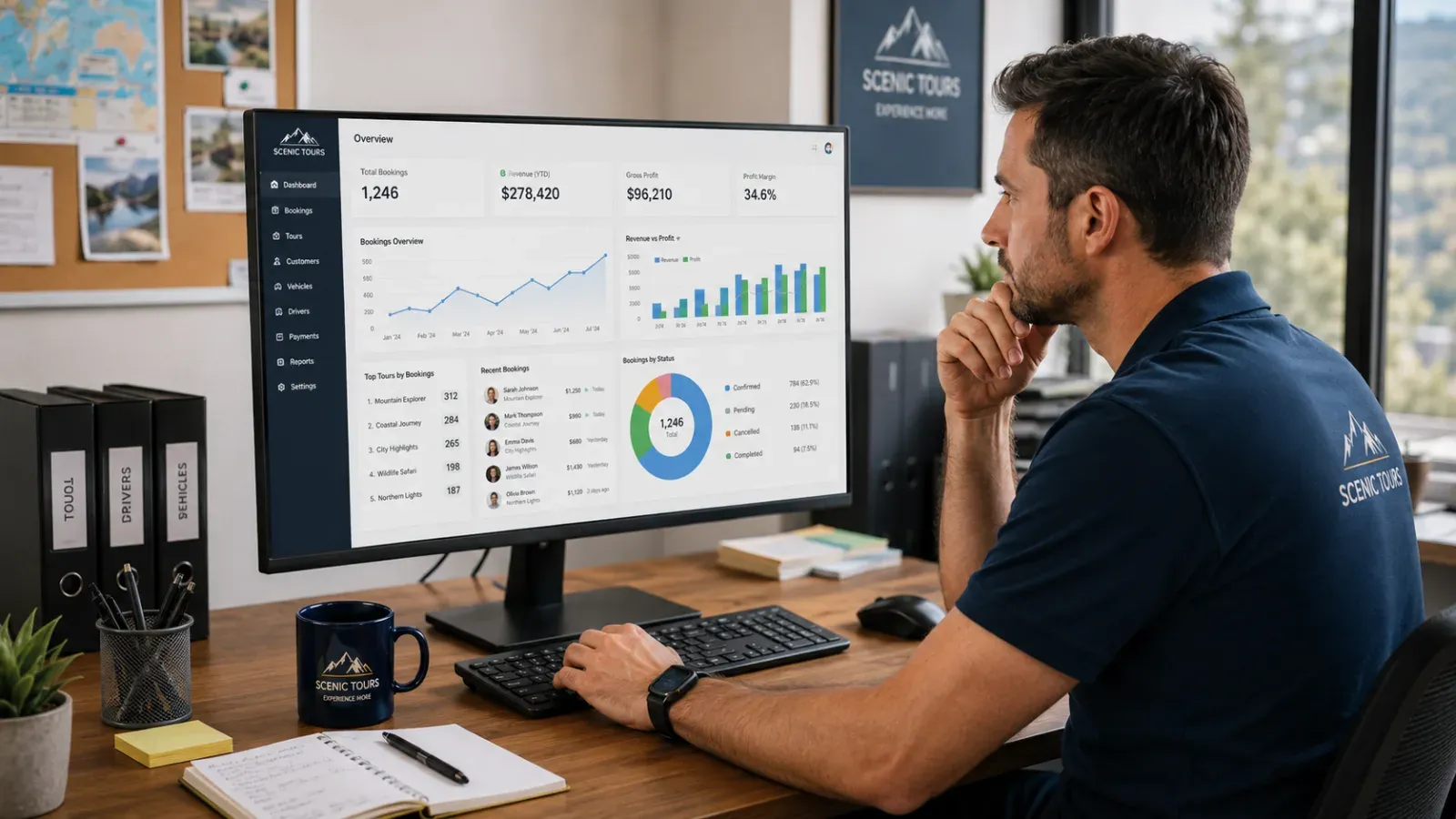
Many tour operators focus on one big number: bookings.
More bookings feel like success. A full calendar feels like growth. Busy guides and full vehicles make the business look healthy.
But bookings alone do not show profit.
A tour can be fully booked and still make very little money.
This happens when the operator does not clearly track the real cost of delivering each activity.
The booking value is only the top line. The real profit depends on what it costs to operate the tour.
Why tour profitability is hard to see
Tour businesses are operationally complex.
A single activity may include:
Guide cost
Driver cost
Vehicle cost
Fuel
Parking
Tolls
Equipment cost
Maintenance
External vendor cost
Commission
Channel fee
Refunds
Discounts
Weather cancellation cost
Customer compensation
Staff overtime
Cash collected on site
Unpaid balances
Currency differences
If these costs are not connected to the tour itself, the operator may not know which products are truly profitable.
They may only see revenue, not margin.
Common ways tour operators lose profit
1. Channel fees and commissions are not tracked clearly
Bookings often come from multiple sources.
Some come through online marketplaces. Some come direct. Some come through partners. Some come through phone calls, WhatsApp, walk-ins, or social media.
Each channel may have a different cost.
If the operator only tracks gross booking value, they may not see how much money is actually received after commissions, fees, discounts, or partner payouts.
A product that looks successful on volume may be weaker when channel costs are included.
2. Transport costs are underestimated
Pickup and drop-off can quietly reduce profit.
Vehicle rental, fuel, parking, tolls, driver pay, waiting time, route inefficiency, and last-minute changes all affect the final margin.
If transport cost is not connected to the specific tour, the operator may underprice products or accept bookings that are not worth the operational effort.
This is especially important for private tours, hotel pickups, airport pickups, multi-location routes, and activities outside the city center.
3. External vendors are paid without clear tour-level visibility
Many tour operators depend on freelancers, rental companies, local partners, photographers, transport suppliers, or specialist guides.
If vendor costs are tracked separately from the tour, it becomes hard to know the true profit of each activity.
The business may know how much it paid the vendor, but not which product, date, customer group, or booking source caused the cost.
That makes pricing and planning difficult.
4. Staff payouts are calculated manually
Guides, drivers, and freelancers may be paid in different ways.
Some are paid per tour. Some are paid per hour. Some are paid per day. Some receive commission. Some receive bonuses. Some rates change by product, language, location, or season.
When this is calculated manually, mistakes and disputes become more likely.
Even when the calculation is correct, the operator may still struggle to understand staff cost per tour.
5. Refunds and cancellations are not connected to root causes
Refunds are not always random.
They may be linked to weather, pickup delays, guide issues, overbooking, unclear communication, missing waivers, equipment failure, or customer dissatisfaction.
If cancellations and refunds are not tracked by reason, product, channel, staff member, location, or resource issue, the business cannot easily see what is causing the loss.
Without that visibility, the same problem repeats.
Why product-level profitability matters
Tour operators often have multiple products.
Some may be high-volume but low-margin. Some may be low-volume but profitable. Some may be operationally difficult. Some may create too many complaints. Some may require expensive resources. Some may depend heavily on external partners.
If the operator does not track profit by product and tour instance, they may keep pushing the wrong products.
They may invest marketing effort into activities that create work but not profit.
A better question is not only:
“How many bookings did we get?”
The better question is:
“Which tours are actually worth running?”
What operators should track per tour
To understand profitability properly, operators should connect financial data to the actual operation.
That includes:
Booking value
Booking source
Channel fee
Commission
Staff cost
Guide payout
Driver payout
Vehicle cost
Rental cost
Fuel and parking
Equipment cost
Vendor cost
Refunds
Discounts
Cash collected
Unpaid balances
Currency
Final gross margin
Operational issues
Customer feedback
When this information is connected to the tour, the operator can make better decisions.
They can adjust prices, remove weak products, improve routes, renegotiate vendor rates, reduce refunds, and focus on profitable channels.
How Rebridpro approaches tour profitability
Rebridpro is not a payment processor and does not replace where customers book.
It is designed to help operators manage and understand the operational side of the business after bookings arrive.
For profitability, Rebridpro’s role is to help connect bookings, channels, staff costs, vendor costs, transport costs, commissions, refunds, cash collection, and settlements to the actual tour operation.
This helps operators see the difference between revenue and profit.
The goal is not only to know that a tour happened. The goal is to understand whether it made sense financially.
Better operations create better margins
Profitability is not only a finance problem.
It is also an operations problem.
A tour with poor pickup planning may cost more. A tour with missing staff may require expensive replacements. A tour with unclear customer communication may create refunds. A tour with unreliable vendors may damage reviews. A tour with weak scheduling may waste vehicle capacity.
When operations improve, margins can improve too.
Final thought
Tour operators should not judge success only by booking volume.
A full calendar is useful only if the activities are profitable, organized, and repeatable.
Tracking profit per tour helps operators understand where money is made, where money is lost, and which parts of the operation need attention.
For growing tour and activity businesses, this visibility can be the difference between being busy and being profitable.
